Casting & Range
Mastering data conversion, navigating the limits of memory, and writing efficient shortcuts.
Too Much for the Cup
When a big drink meets a small cup, something has to be left behind.
The Problem
Why can't we just assign a double to an int?
Java is strict
double holds more information than an int. Java refuses to silently lose that data. The solution: Cast
Casting
Changing types: Narrowing vs. Widening
Narrowing
double → intWidening
int → doubleSyntax
(int) someDouble — converts a double to int(double) someInt — converts an int to doubleTruncation Rules
Casting cuts the decimal — it never rounds
99.9 → 99
3.9 → 3
-2.9 → -2
Casting Quiz
Truncation & widening
Rounding Strategy
How to achieve (nearest int) instead of just truncation
Positive Numbers
0.5 before casting. (int)(x + 0.5)Negative Numbers
0.5 before casting. (int)(x - 0.5)The Logic
Integer Overflow
What happens when you exceed the limit?
-2,147,483,6482,147,483,647Overflow Quiz
What happens when numbers exceed their limits?
Round-off Error
Why doubles are sometimes 'approximate'
Limited Precision
Some decimal values cannot be stored exactly as doubles. Java keeps a very close approximation instead.
The Result
This leads to tiny precision errors during calculation — doubles are not always exact.
Compound Operators
Write less, mean the same — each line starts from xp = 10
Pattern
x op= y is always equivalent to x = x op y. Compound Quiz
Decode the shortcut operators
Increment & Decrement
The ultimate one-step shortcut
x++ (Increment)
x = x + 1.Increases the value by exactly 1.
x-- (Decrement)
x = x - 1.Decreases the value by exactly 1.
Increment Quiz
++ and -- in action
💡 Increment in Assignment
This pattern is useful to recognize, but it is not part of the AP CSA exam focus.
Increment Expression
Try tracing this one step by step before you trust your intuition.
Direct Swap?
This looks reasonable at first glance. What value disappears?
Think First
a = b, what is the value of a? When the next line runs, does the original 7 still exist anywhere? Swap Visual
Before we write the fix, look at where each value moves.
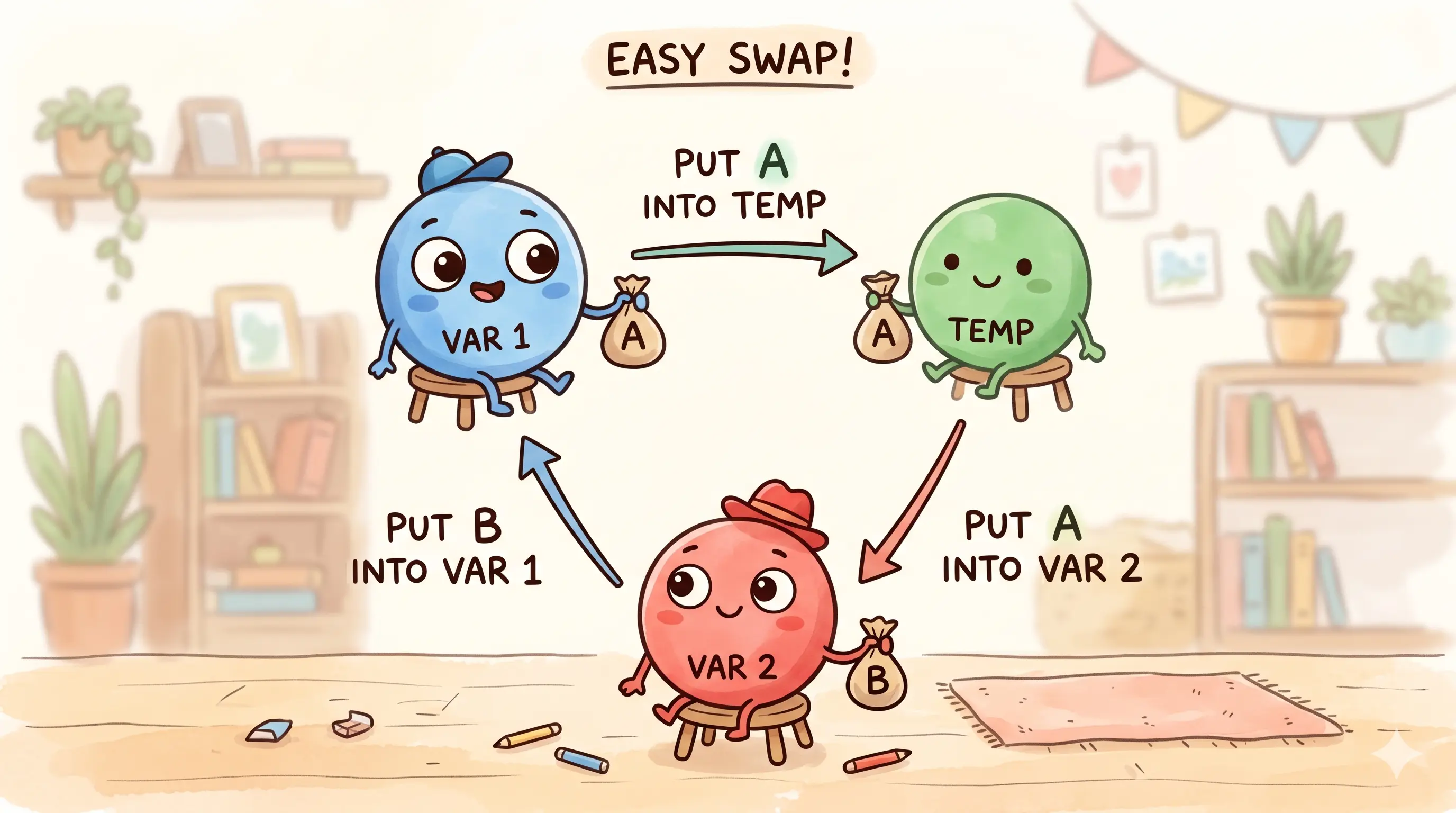
Swap Two Values
A temporary variable keeps one value safe while the other moves.
Summary
The four things you must remember
Casting is explicit
(int) 3.9 → 3 (truncation, not rounding)
32-bit Integer limits
Integer.MAX_VALUE + 1 wraps to MIN_VALUE (Overflow)
Doubles aren't exact
0.1 + 0.2 can equal 0.30000000000000004 (Round-off Error)
Shortcut Operators
x += 5 (compound) and x++ (increment) save time